
Ugliness: A reflection
Reflections from food rescues with Fridge Restock Community Singapore

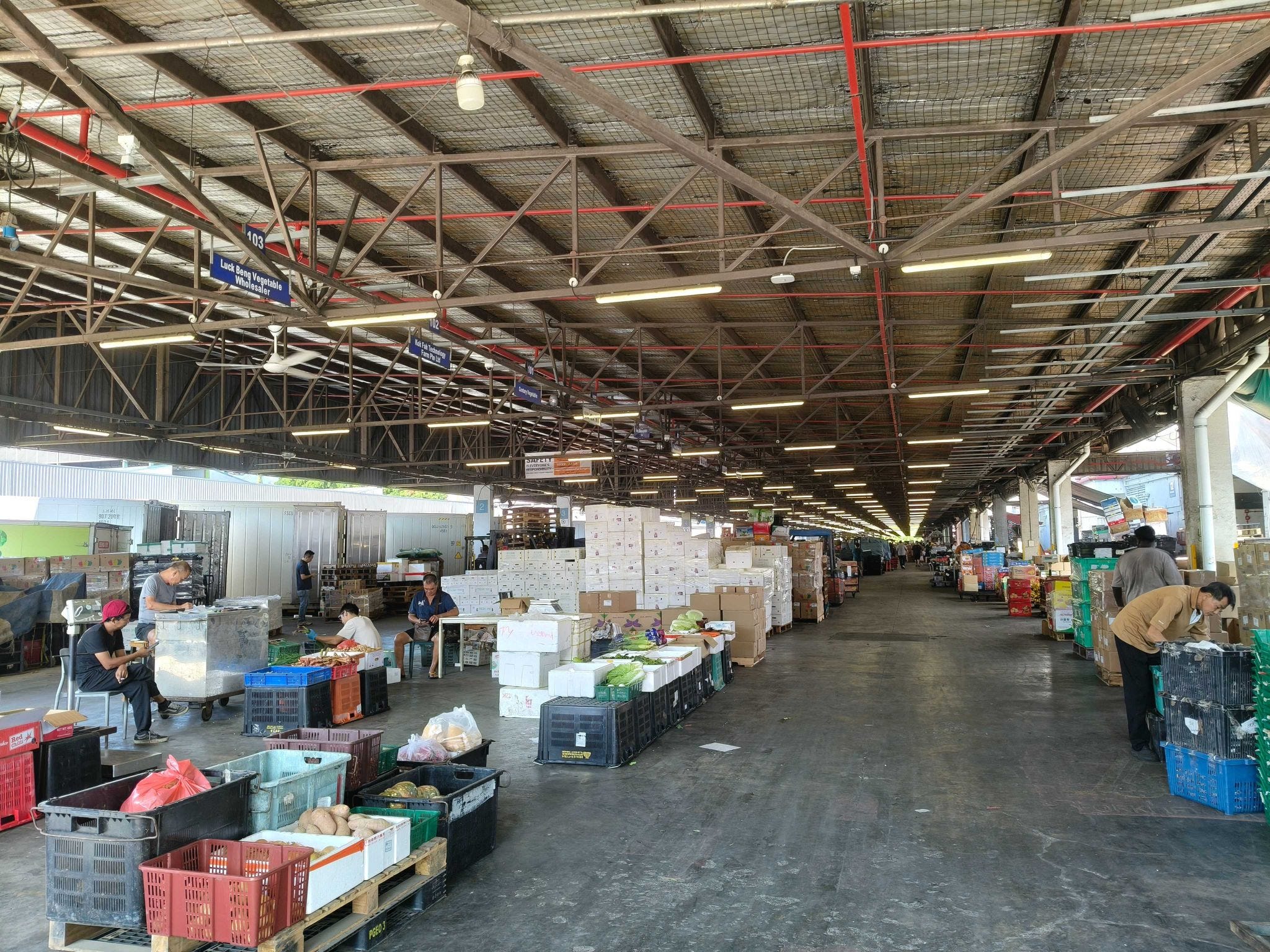
I’ve recently started volunteering with a group called Fridge Restock Community, which organizes food rescues multiple times every week at Pasir Panjang Wholesale Centre. Each rescue has a cap on the number of people that can take part, so we have to register through a senior volunteer. The intention is to collect produce that is considered too ugly to be sold by the vendors, but which are still in edible condition, then redistributing all of this food to community fridges dotted all over the island. You can find out more about them on LinkedIn, Instagram, or Facebook, where they post regular updates of their rescues.
After each rescue, regular volunteers can go “shopping”, which is to say that we can choose some of the rescued produce to bring home with us as if we were buying them from a supermarket or wet market. I’ve taken home two bags of produce so far, and cooked about 60 portions’ worth of food for my family and partner. The scale of food waste can be mind-boggling - I calculated that each time I go for a rescue the value of my shopping can be about S$150 to S$200 if you calculate the average cost of a meal as S$5, and there are at least 10 volunteers per rescue and 3 rescues a week, and at least about 90% of the rescued food goes to the fridges, not to us. That’s nearly S$28,000 worth of food waste processed by the team (into both our own fridges and the community fridges) per rescue, or between S$1 million to S$4 million worth of food waste per year taking into account conservative estimates (3x rescues per week rather than every day, 10 volunteers per rescue as opposed to 20). Given that this is just the figure for Pasir Panjang Wholesale Centre, rather than inclusive of, say, Sheng Siong and NTUC supermarket waste, that’s an astonishingly high amount of food (and economic value!) wasted on an annual basis. A senior volunteer bemoaned to me that supermarkets are a lot more secretive about their food waste streams because they want to be associated with only pristine food, but it is precisely these beauty standards that are harming us.
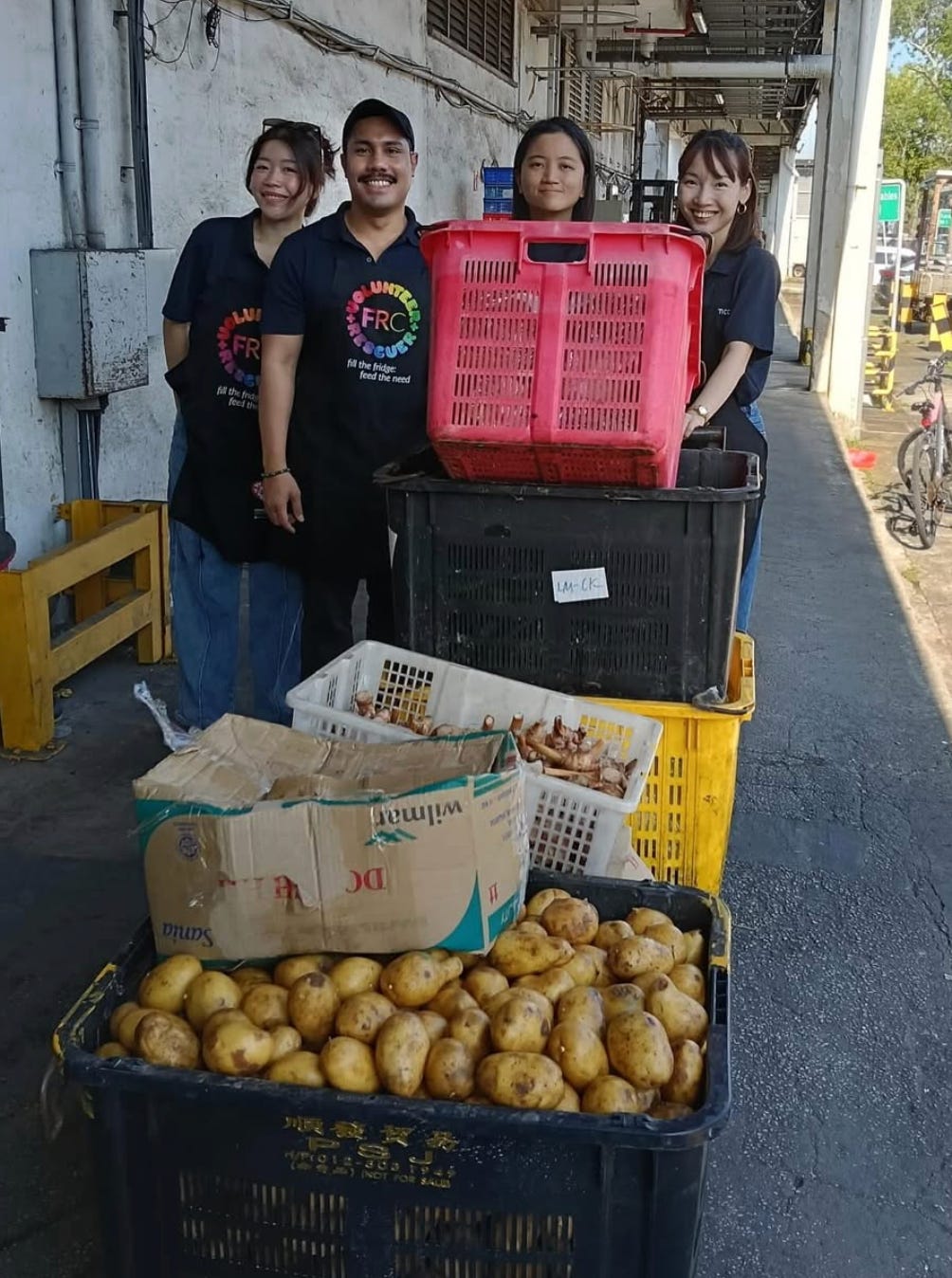
I have never tried weighing the produce, but I did take part in the 500th rescue (first photo below) organized by FRC; suffice to say there have been thousands of kilograms of food rescued so far.
I have some photos, some of which were taken by me, and some by the FRC senior volunteers. Here they are:
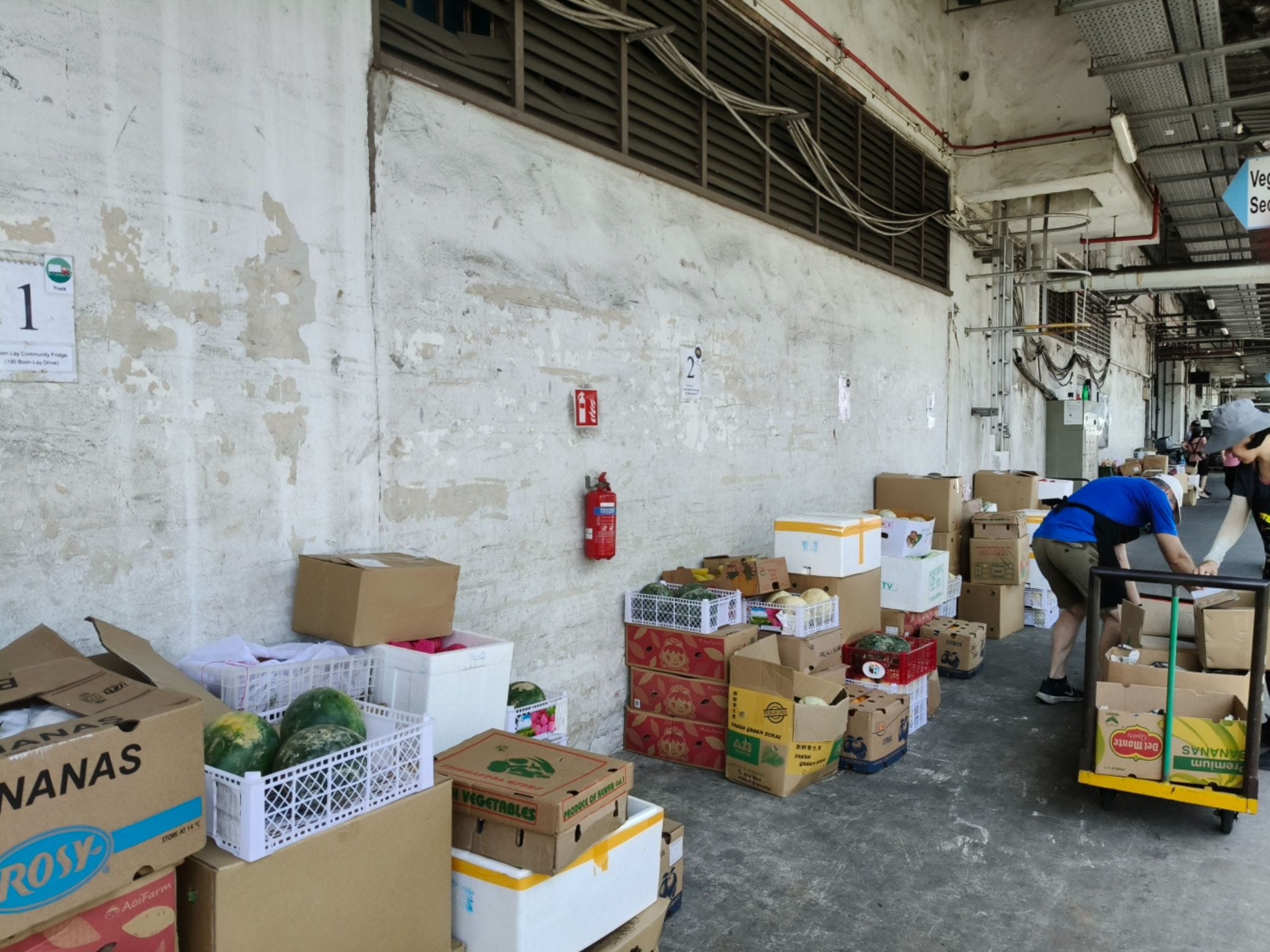
In the third photo, the food is organized by category into heaps destined for different community fridges. Often, the only "problem” with the food is that it looks a little different from photographs that have become part of our common perceptions of how food should look - apples and oranges that are a little dented, potatoes that are irregularly sized, peaches that have bruises on one side, and so on.
I was intrigued by how food rescue and questioning beauty standards for produce segued into Do-It-Yourself culture and repairing broken items found in apartment block void decks and bins for one of the veteran volunteers I spoke to, which reminded me of my first ever internship that was hosted in a warehouse in Tai Seng area where my ex-boss was renting out DIY tools for Home-Fix Pte Ltd. (The chain has since closed most if not all of its stores, due to harsh competition from online marketplaces.) In many ways, the freegan movement also questions consumerism and the relationship between price and value, which challenges the market power of hyper-consumerist chains like Shein and platforms like Taobao.
Thus, ugly items that are thrown out, like fans or luggage or hair dryers, can be “rescued” (albeit your mileage may vary based on your repair skills) just like ugly food can be rescued (e.g. cutting off bruised parts or carving away sprouted eyes of potatoes). Through sharing groups on WhatsApp or other social media platforms, they can then be accessed by people who may not ordinarily have the economic power to buy these items new, especially migrant workers or lower-income families in Singapore, or enjoyed by those who would like to save some money instead of buying a new item. In the long run, it reshapes our understanding of value to go beyond price stickers and prestige associated with owning the newest and most expensive items, or items that are branded and on sale (think flash sales on 11.11). Rather than storing objects in one’s store room, we only buy what we need and what we are sure we can’t get from sharing groups, and we can share our unnecessary items out there with the community as well so that they get put to good use rather than collecting dust while in our personal ownership.
The line between what is individual and what is communal therefore can be reimagined with concepts like the sharing economy and gift economy - think Airbnb which has transformed the hospitality industry without owning property, and Grab and Uber which have transformed transportation without owning vehicles. How might we reimagine our food systems and understandings of success, if it were not so focused on owning stuff and having more money?
Of course, the teething problems that have arisen as a result of companies like Airbnb, Grab, and Uber means that they are imperfect. Housing markets can become highly saturated as landlords speculate on homes in order to profit from renting them out, reducing the number of homes available for private individuals to live in. Grab and Uber drivers, up until very recently in countries like Singapore, were part of the gig economy and did not enjoy traditional protections like paid leave, medical leave, or pensions (recently changed in Singapore with CPF rulings). The gig economy parcels out what used to be full time jobs and turns it into smaller paid transactions that offer no guarantees for the workers, and in some creative industries like music, can turn exploitative when workers are afraid of censure if they speak up about unpaid fees as employers expect them to work free for the sake of exposure. So the sharing economy and gig economy hold great promise for unlocking use and value in idling resources that we already have, offering a less resource-intensive way to lead a good life, which is definitely good for the environment. Regulatory approaches have to keep up with these paradigmatic innovations.
But what I’m interested in looking at is also the transformation of how we look at ourselves, when we challenge aesthetic conventions about stuff. Does that change how we look at our relations with one another, as human beings and not just how we relate to our possessions? And perhaps our understanding of ourselves?
If we don’t have to eat perfectly round apples or regularly sized potatoes in order to be well-fed, how might that be taken one step further to look at what is a life well-lived? Nature did not grow apples to be all the same size to fit our cylindrical plastic tubes in the supermarket perfectly. And nature did not grow potatoes to all be the same exact shade of brown and yellow, or the size of a fist. Some are big, and some are tiny, and that’s just natural variation. Is it possible to extend the same tolerance to human diversity?
In Singapore, accepting ugliness in how we look at each other would dig into questions of whether we are compassionate towards those whose careers aren’t that illustrious or high-earning, children (despite Asian parenting anxieties) whose academic performance constantly need help from tuition teachers or remedial classes in school, or sons and daughters of marriage age who are socially awkward and thus not really adept at the dating game, who may tap out of wanting marriage altogether. Ugliness is a shorthand for socially rejected variants of imperfection - how do we treat someone who is too short, too fat, and at more serious levels, possibly more serious problems like a disease or a genetic condition that affects a limb or a bodily function like sight? Do we throw them away from our understanding of who fits into community and society, the way the wholesale centre throws away ugly produce?
One dimension where this has been very real for me has been in the realms of dating and how I see career and work. In a society that has defined good jobs as certain strata of cushy and linked to white collar offices, airconditioning, 9 to 5 hours, and certain pay levels as rewards, freelancing or gig approaches to earning a living can cause anxiety because it is unstable, and makes oneself worry about looking “ugly” and unattractive on the dating market. This is even as I witness for myself friends and acquaintances who are walking the more orthodox paths who are also grumpy and unfulfilled from chasing material goods way past the point where the material enjoyments make them happy; just as there are happy and conventionally successful people, there are also unhappy ones, and I learned from their secondhand experiences how to optimise my own life for community, impact, and meaning.
In my case, having struggled with mental health several years ago, and having taken a much longer time than most people to finish undergraduate studies, I sometimes worry that I’d be seen as “ugly” in the sense of undesirable and thus undeserving by people who control access to resources. (Looking at the experience of a distant friend who had to drop out of undergraduate studies while chronically unhoused and who had bad mental health, it is also arguably class privilege that I was able to finish undergraduate studies at all. I will always be grateful for that.) The fear of being seen as imperfect to an unacceptable level beset my interactions with interviewers, potential employers (be it formal employers or in the tuition industry), potential romantic partners, or friends who hewed more closely to the traditional yardsticks of success. Thankfully, my extended family has been supportive, with cousins coming to visit me with food and encouraging words, and spiritual advice from their respective religions. It took me quite a bit of therapy and looking for new third spaces like A Public Living Room in Pearl’s Hill Terrace, and a composting course with Living Soil Asia, to rethink the way I have internalised these market competition values and capitalism into muscle tensions and anxieties. I haven’t fully fled those anxieties, but I have dug my way out of potential midlife crises to a much greater extent than before.
In industrial modern capitalist societies, our systems of production have also defined that in developed countries the following structure emerges — a vanishingly small minority (1-5%) get to live the lives of luxury that is pictured in the cover pages of glossy magazines, a middle class that is plagued with loss of pathways to structured upward mobility especially aggravated by automation of jobs, and an increasingly reactionary and nationalistic working class that is suspicious of immigrants stealing jobs. It’s easy to bemoan the problems, and to suspect that something is deeply wrong somewhere, and hard to solve these problems.
I argue that linked to the ugliness in food and ugliness in thrown-away consumer products, the ugliness and rot started long ago in economic and political systems way before societies like the UK and US began to be beset with such unhealthy politics and social tensions. Central to the process of offshoring manufacturing and industrial production was the idea that it doesn’t matter where or how an object was produced, only how much the production cost, or how much it can be sold for. These considerations, which we reduce to the shorthand of “cost-benefit analysis”, ignore how dignified work creates social meaning, status, and community for workers, unemployment in places that have lost factories and shops can lead to social alienation, there is an enormous environmental cost associated with satiating our desires for certain aesthetic standards to be upheld by the manufacturers (e.g. clothing that doesn’t pass quality control being thrown away, or secondhand clothing donated to Salvation Army ending up in UAE, Pakistan, or Africa). When offshoring of factories happened in many Anglophone countries, shifting production from developed economies to developing economies, societies were transformed with vocabulary like “emerging economies”. But into what visions of the future are they emerging? Is the old economic model built in the 19th century, really a sustainable and nourishing model of success for these current economies that are the world’s workhouse, given that they have also caused global warming with carbon emissions and require exploitative systems of production?
Prices and labour costing are all numerical yardsticks, much like the superficial aesthetic yardsticks of whether an apple or potato is pretty. In reality, what we need is objects that serve our needs, which don’t have to be pretty, just like how food that nourishes us doesn’t have to be of a specific size or pristine. How do we live with ugliness in people and human interactions? One interesting article that I read recently talked about the idea of a Disneyland class, which is built into the aspirational ideals of many in the developed world. These societies have built in a materially luxurious ideal of a good life as attainable at least once in awhile as part of their pay off in exchange for hours spent grinding in offices and on public transport. As I once remarked to a horrified office worker bee acquaintance, the MRT on a work day is not so different from the pens of industrial animal agriculture where chickens, cows, and pigs are shunted through and poked and prodded to maximise their material output. Instead of laying eggs, the urban middle class makes spreadsheets and powerpoint documents; instead of being slaughtered with electric prods, the East Asian industrial urbanite risks death by karoshi, depression, and burnout.
To what end? Our current systems arose from an environment of scarcity in the post-WW2 but no longer serve our needs today. Just as the postwar baby boomer generation had to build institutions that served their needs, so too does our generation have to innovate and implement intellectual solutions to the climate crisis and limited resources on a finite earth. 19th century models that assumed infinite supplies of natural resources just don’t work anymore in a system rapidly exceeding planetary boundaries.
Our focus on quantifiable, external yardsticks of success and prettiness are suffocating the life out of humans and nonhumans alike, holding us ransom and depleting the earth’s resources faster than they can be replenished. How might community and meaning be woven into the way we work? It would parallel the way that food rescue and freegan approaches to food would focus on nourishment and food security for all, as an intellectual bulwark against food waste. Spirituality can offer answers to how to deal with the ugliness in the human condition that spurs greed (hi, self-interest in rational economics), cruelty (hi, war in Gaza starving children to death), and the demonisation of groups of people different from ourselves, but ultimately is incomplete without larger structural change.
What can we do in the meantime? I think we can all challenge ourselves to question beauty standards - not just for our next meal or purchase, but indeed what we think a good life needs to look like. It can transform our ability to rest, to feel contentment, and to feed, clothe, and equip more people around us to share what we have and all have good lives together. Perhaps embracing what is ugly and seeing the craft and artwork in the repaired cracks of imperfection, is key to beauty after all.
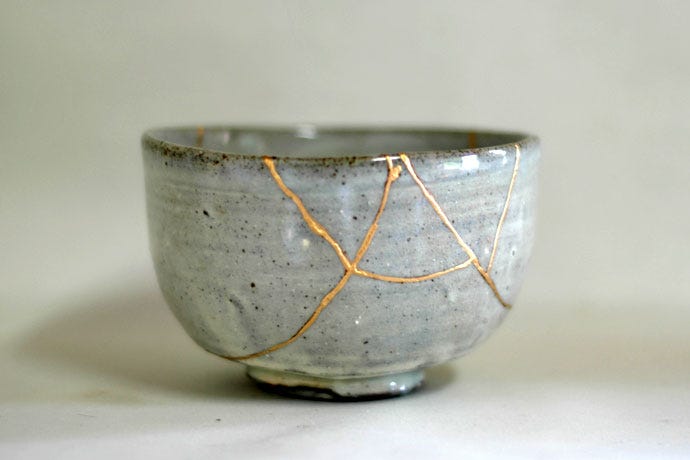
Kintsugi - a kind of Japanese lacquer joinery using gold to glue together ceramic pottery, where imperfection is not hidden, but indeed celebrated.